



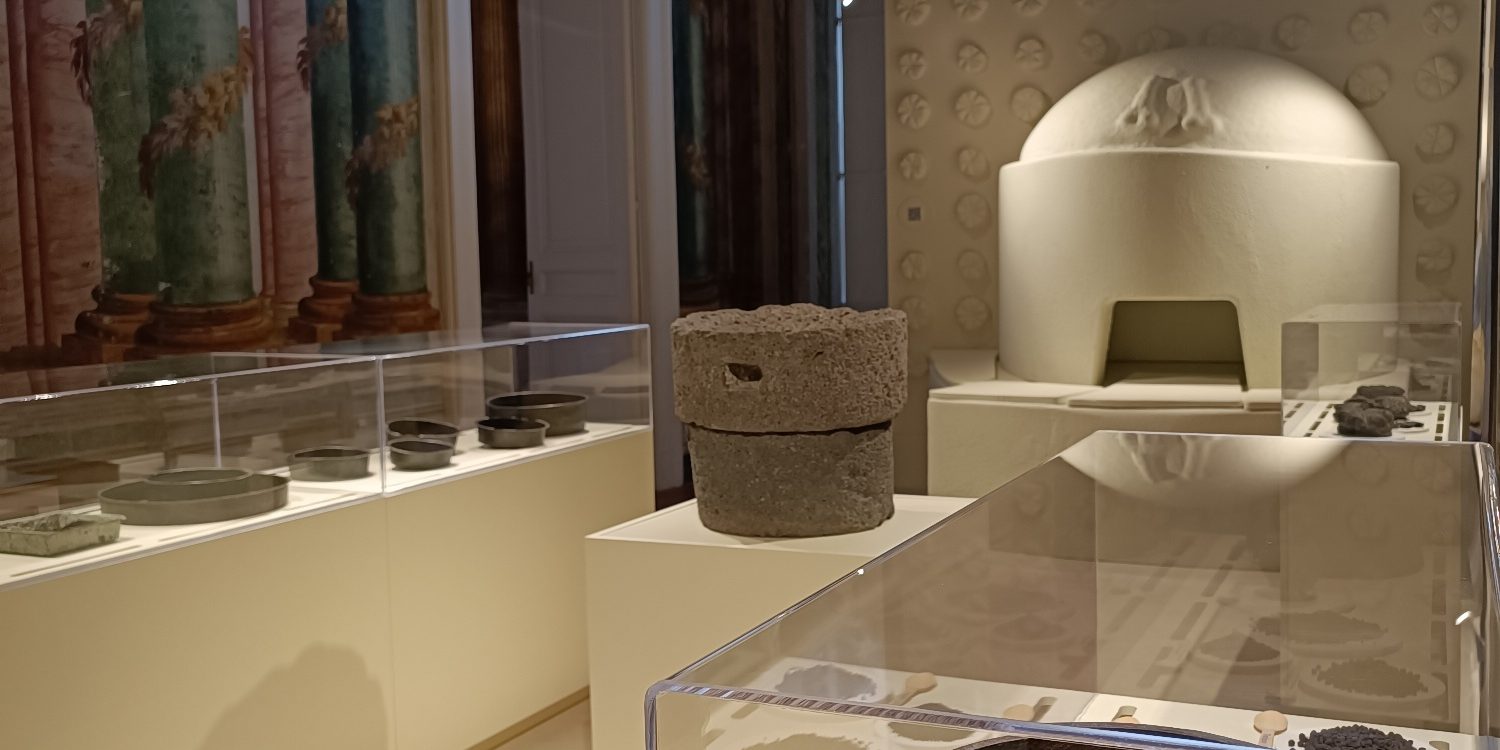
“From Eggs to Apples. The Civilization of Food and the Pleasures of the Table” is the new exhibition at the Herculaneum Archaeological Park, organized in collaboration with the Fondazione Ente Ville Vesuviane and hosted in the frescoed rooms of Villa Campolieto, one of the most fascinating Bourbon-era villas on the Golden Mile. Starting March 28, visitors will be immersed in a journey back to the Roman era to discover what we might call a true civilization of food. Food is a common thread linking the present to the past, not only through basic biological needs. Never before has a relationship with food emerged so clearly, one that focuses not only on the quality and variety of products, but also on the care taken in preparation and the gastronomic outcome.
Between a present evoked by images drawn from the present-day reality of modern Herculaneum and Roman antiquity, the exhibition never loses sight of the beauty of Vanvitelli’s Villa Campolieto, with open spaces that interact with its precious setting. Walking through the rooms, one enjoys both the exhibits on display and the splendid eighteenth-century residence itself. The refinement and historical value of Villa Campolieto’s main floor required a respectful exhibition approach; hence the idea of the “room within a room,” a display that creates a dialogue between past and present.
The more than 300 skeletons of fugitives found on the ancient beach of Herculaneum have provided data on the health of the population and the food they ate: they were on the men, women, and children who populated the streets and houses of ancient Herculaneum, whose lives never truly ended, but have somehow reached the present day, fixed forever in those streets and passed down to the future through the generations.
The poet Horace stated, “From egg to fruit”—a complete meal in ancient Rome usually began with eggs and ended with fruit—and like a silver platter, ancient Herculaneum presents us with a vast quantity and variety of organic remains in exceptionally well-preserved condition, demonstrating an enviable assortment of foods and foodstuffs. A raw material and the fruit of astonishing culinary art, the food of this Roman city is revealed through the charred remains of bread, grains, legumes, fruit, eggs, cheese, and seafood; we can almost smell their aromas. In addition, there are crockery, pots, utensils, and everyday and luxury items, which provide valuable information on the main aspects of the diet of the ancient Herculaneum residents: from production to consumption and disposal.
“Food, not only as a physiological necessity, but as a central element of cultural and social life, represents a constant link with the contemporary because many ancient traditions and customs persist even in today’s Campania culture – declares the Director of the Park Francesco Sirano Tastes, recipes, and table etiquette have changed in the more than two thousand years since 79 AD, but we share a common concern for the quality of raw materials, often imported from Africa and India in Roman times, for the preparation and presentation of dishes, and, most importantly, for hospitality and the sharing of meals, especially on the most important occasions.
The exhibition – adds the Director – represents for me the completion of a journey – we began with luxury objects in the Park’s Antiquarium, moved on to the celebration of wood at the Royal Palace of Portici, and ended with food at Villa Campolieto. In a circle of valorization of the peculiarities that make Herculaneum unique in the world, with the Park’s finds ambassadors of values in an area much larger than the restricted walls of the Archaeological Park. A journey – concludes the Director – who saw us in the company of local authorities, cultural institutions and many voluntary organizations in these splendid territories”.
The project for this exhibition began in 2018, when the exhibition program “Herculaneum 1738-2018 Talent Past and Present” was launched. This included a series of three exhibitions on the most significant finds from the ancient city—namely, gold, wood, and food—and consequently on aspects of this ancient community related to luxury, craftsmanship, and eating habits. This initial project also included the desire to stage the three exhibitions in the most beautiful locations in the area. The Antiquarium of the Herculaneum Archaeological Park was the venue for the exhibition ” “SplendOri. Luxury in the ornaments in Herculaneum ”, the Royal Palace of Portici hosted the exhibition “Materia. Miglio d’Oro.
“We are proud to host this prestigious exhibition at Villa Campolieto,” says Gennaro Miranda, President of the Fondazione Ente Ville Vesuviane. This event is the result of an extraordinary collaboration with the Herculaneum Archaeological Park and represents a virtuous example of synergy between institutions united by the common goal of promoting the history and beauty of our region. Food culture, once a symbol of social interaction and well-being, remains a powerful economic and social driver for our region today. Local food and wine continues to shine for its authenticity and its typical products, which, as in the past, are not only an economic resource but also a symbol of pride and identity for the entire community. The exhibition is more than just an exhibition; it is an extraordinary journey through time, allowing us to explore the art of food in ancient Herculaneum and its nutritional, social, and cultural value.
The pleasures of the table, culinary traditions, and conviviality were fundamental aspects of daily life for the ancient inhabitants of Herculaneum, and today, in the heart of the Golden Mile, we can continue to celebrate and rediscover those same traditions, which are still an essential part of our daily lives and tourism offerings. Villa Campolieto thus becomes a bridge between past and present, a place where historical memory dialogues with our times.
I sincerely thank the Minister of Culture Alessandro Giuli and his predecessor Gennaro Sangiuliano, the Archaeological Park of Ercolano and its Director Francesco Sirano for having contributed to making this project possible, which I am certain will leave an indelible mark on the cultural memory of all those who will have the privilege of visiting the exhibition.”
Matteo Lorito, rector of the University of Naples Federico II declares The exhibition, masterfully staged in one of the most beautiful Vesuvian villas, enriches the extraordinary offerings of the Ercolano Archaeological Park. Our Department of Agriculture has long been engaged in a fruitful collaboration with the institution, for which it has also hosted the unique exhibition on the Herculaneum woods at its headquarters in the royal palace of Portici. This collaboration now extends to the era of food and the study of organic and food-related finds. These provide us with a truly impressive wealth of information and insights into our past, including aspects of food and wine as well as agricultural production. Food tells us who we are, how we live, and, in this case, who we were and the path that has brought us to the present day.