



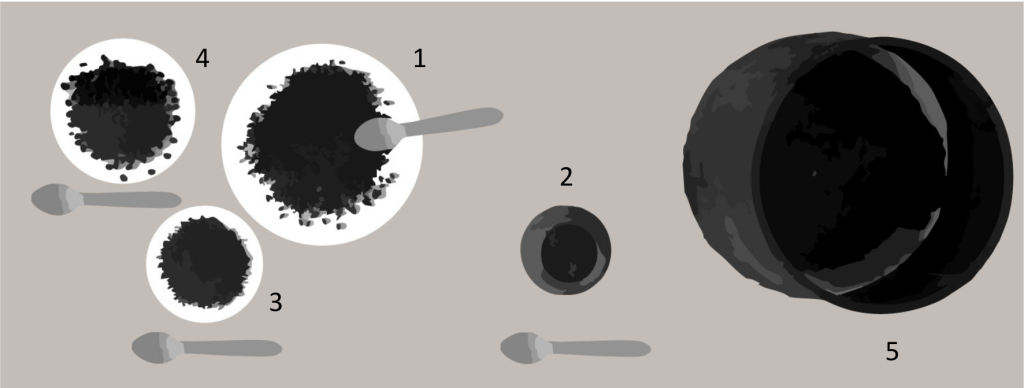
Cereals and legumes formed the basis of the diet in the Vesuvian area during the 1st century AD, and were used in the production of bread, porridges, and soups. Displayed in this showcase are the most common cereals among the carbonized botanical remains found in Herculaneum: emmer wheat (1), commonly referred to as spelt (Triticum dicoccum), and barley (Hordeum vulgare). In this particular case, barley was found mixed with emmer wheat seeds inside a small pot (2), providing evidence of the combined use of multiple species in food preparation.
The term “wheat,” synonymous with frumentum in Latin, includes various species of the Triticum genus. According to Pliny, in 1st-century AD Italy, the most widely cultivated types were soft wheat (Triticum aestivum), emmer (Triticum dicoccum), and durum wheat (Triticum durum). At Herculaneum, only emmer wheat has been found, widely cultivated in Italy, of Middle Eastern origin, hardy, and resistant to cold. Its name is the root of the word “flour.”
Cultivated barley (Hordeum vulgare), another extremely hardy cereal, was also used for beer production as early as ancient Egypt. To these we can add millet (3 – Panicum miliaceum), represented here by specimens found along the northeastern side of Herculaneum’s Decumanus Maximus.
Legumes, on the other hand, were a crucial source of plant-based protein and helped balance the Roman diet. Among the most common, found in households and displayed in this showcase, is the broad bean (4 – Vicia faba var. minor), an ancient variety of fava bean no longer used for human consumption today, but widely eaten in Roman times and earlier periods. The specimen shown was found in a small carbonized basket in the House of the Wooden Partition (Casa del Tramezzo di legno).
The bronze modius (5) on display here was a tool used for measuring cereals. Truncated-conical in shape, it corresponded to a unit of dry measure equal to one-third of an amphora, about 8.6 liters. This particular modius comes from a shop with living quarters (V, 17), offering concrete evidence of commercial and domestic activities related to grain processing and distribution.