



Breakfast in ancient Rome, known as the ientaculum, was a simple yet meaningful part of everyday life.
It was typically consumed in the early hours of the morning, often while standing or seated informally, before the start of daily activities.
Among the most common foods were bread, figs, olives, and spelt, accompanied by water or light wine. Yet even within this essential context, objects and gestures tell us far more than might appear at first glance.
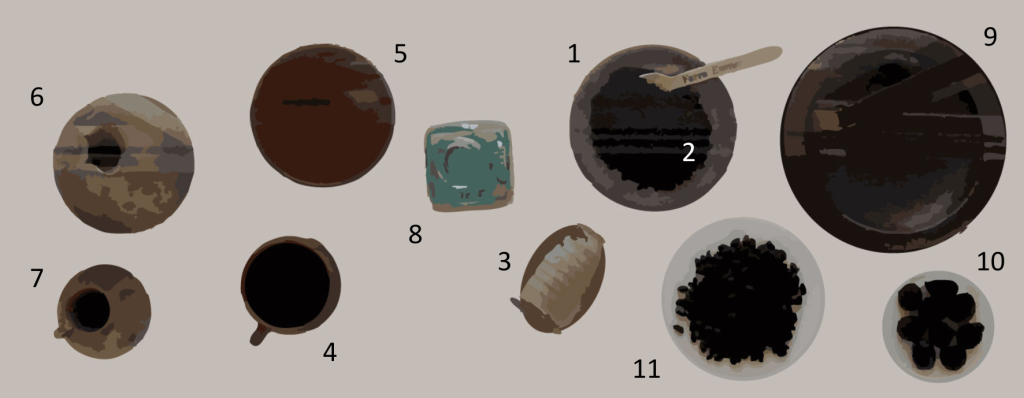
The meal took shape around everyday containers, such as a ceramic plate (1) with a shallow basin and rounded rim—simple yet functional, suited to generous portions. In the example on display, spelt grains (2 – Triticum dicoccum) are laid inside. This staple of the Roman diet was found on the upper floor of an unidentified house along the Decumanus Maximus.
Next to it are ceramic drinking vessels (3), cups, and small bowls. Particularly notable is a small bowl (4) decorated with a herringbone motif created using a roller-stamping technique, evidence of aesthetic care even in the humblest objects. A hemispherical cup (5) with dark orange slip recalls typical shapes from the Late Republican and Julio-Claudian periods, attesting to the continuity of forms over time.
Two ceramic jugs (6–7), used to pour liquids such as water, wine, or milk, display marked stylistic differences. The first (6), of simpler manufacture, imitates metal forms, highlighting a continuity between materials and shapes.
The second (7), with two handles, is adorned with a raised phallic motif applied to both sides of the neck—a clear reference to the god Priapus, symbol of fertility and protection. This decoration gave the object an apotropaic value, fully in line with the beliefs and practices of the Roman domestic sphere.
Among the more refined items stands out a blown glass bottle (8), likely used to hold fine liquids. Together with a bronze patera (9), it suggests that even breakfast could be accompanied by gestures of elegance. The patera, with its incised lines and decorated base, was not necessarily used for ritual purposes; recent studies increasingly interpret it as a domestic item, possibly for hand washing or to welcome guests with a gesture of care and hospitality.
Alongside the objects, organic remains bring us directly to the breakfast table of Herculaneum, offering precious insights into the foods consumed at this time of day.
In addition to spelt (Triticum dicoccum), dried figs (10 – Ficus carica) are on display, likely preserved since antiquity. Found on the upper floor of a house along the Decumanus Maximus, along with other provisions, these fruits were common, energy-rich, and easy to store.
Lastly, olive pits (11 – Olea europaea), discovered in the House of Neptune and Amphitrite, confirm the presence of olives—flavorful, symbolically rich, and deeply rooted in the culinary culture of the Mediterranean.