



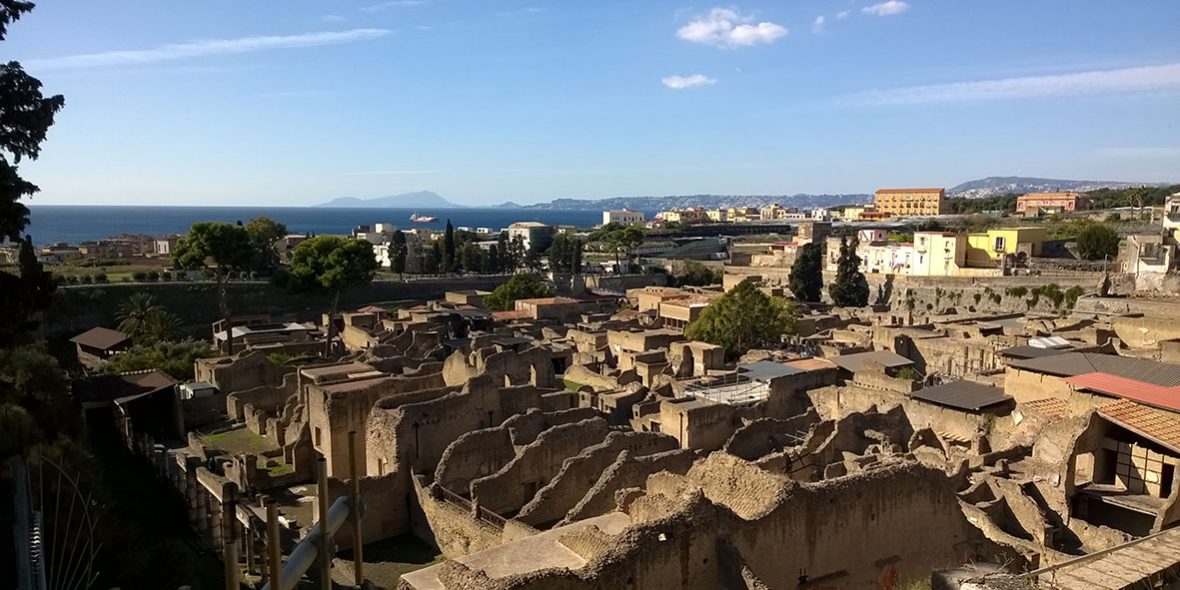
Thanks to the partnership with the Packard Humanities Institute, a unique path of knowledge, protection and valorization has taken shape in Herculaneum which today is the basis of the shared, responsible and sustainable management of the extraordinary heritage of Herculaneum and its territory.
May 16th marks the anniversary of the start of the collaboration between the Herculaneum Archaeological Park and the Packard Humanities Institute, a partnership that, for twenty-five years, has represented one of the most significant international examples of public-private cooperation in the field of cultural heritage protection and promotion.
Established in 2001, the collaboration with the Packard Humanities Institute—through the Herculaneum Conservation Project—has gradually become a true laboratory for managerial and cultural innovation, founded not on the simple provision of funds, but on an advanced form of cultural philanthropy: ongoing, multidisciplinary, and operational support for the public partner, built on shared expertise, responsibility, and strategic vision.
Over the years, the international group of professionals involved has worked side by side with the Park staff, making a significant contribution to conservation, scheduled maintenance, scientific research, training, the digitization of the heritage, and the development of new management tools for the archaeological site.
The ongoing presence of archaeologists, architects, engineers, restorers, conservators, GIS experts, and specialists from various disciplines has enabled us to address the critical issues and potential offered by the archaeological site with an integrated and sustainable approach, capable of transforming Herculaneum into an international reference model.
One of the most innovative aspects of this experience lies in the very nature of the partnership: the Packard Humanities Institute’s contribution has never been configured as a traditional sponsorship, but rather as a philanthropic investment, aimed at structurally strengthening the public entity’s capabilities, without creating dependencies, by transferring methods, knowledge, and tools destined to consolidate over time.
Over the past twenty-five years, the archaeological site has benefited not only from conservation and enhancement efforts, but also from the development of a more modern, resilient, and long-term management system. This experience has fostered the development of innovative practices, advanced digital tools, and shared planning models that today represent a wealth of knowledge available to the entire cultural sector.
“I am taking up the legacy of an extraordinary effort built over the years thanks to far-sighted management and a public-private partnership that has transformed Herculaneum into an internationally recognized model,” said Federica Colaiacomo, Director of the Herculaneum Archaeological Park. Today, the Park is in excellent condition in terms of conservation, management, and planning capacity, the result of a shared and ongoing commitment that has seen the Park staff and the professionals of the Packard Humanities Institute work together with expertise and a shared vision. This shared experience represents a solid foundation on which to continue the path of protection, enhancement, and ever-greater openness to the local community and the international public.
«It is significant – comments the General Director of Museums Massimo Osanna that May 16th marks two key anniversaries in the history of Herculaneum: the 25th anniversary of the start of the collaboration between the Italian State and the Packard Humanities Institute, and the 99th anniversary of the major excavation season directed by Amedeo Maiuri. These two moments have profoundly impacted the history of the site’s studies, protection, and enhancement, helping to transform Herculaneum into an international benchmark. Over these twenty-five years, an advanced form of public-private collaboration has developed, based not only on financial support but on the sharing of expertise, responsibility, and strategic vision. This experience demonstrates how cultural philanthropy can concretely contribute to strengthening the capabilities of public bodies, generating tools, methods, and knowledge destined to consolidate over time. This approach is fully consistent with the Directorate-General for Museums’ commitment to promoting sustainable, integrated, and participatory management models, in which protection, research, innovation, and enhancement of cultural heritage are developed through the shared contribution of institutions, expertise, and shared projects.
Twenty-five years after the collaboration began, Ercolano continues to represent a concrete example of how cultural philanthropy can decisively contribute to the protection and enhancement of world heritage, through a shared governance model that looks to the future with responsibility and vision, restoring to communities beauty and knowledge accessible to all.