



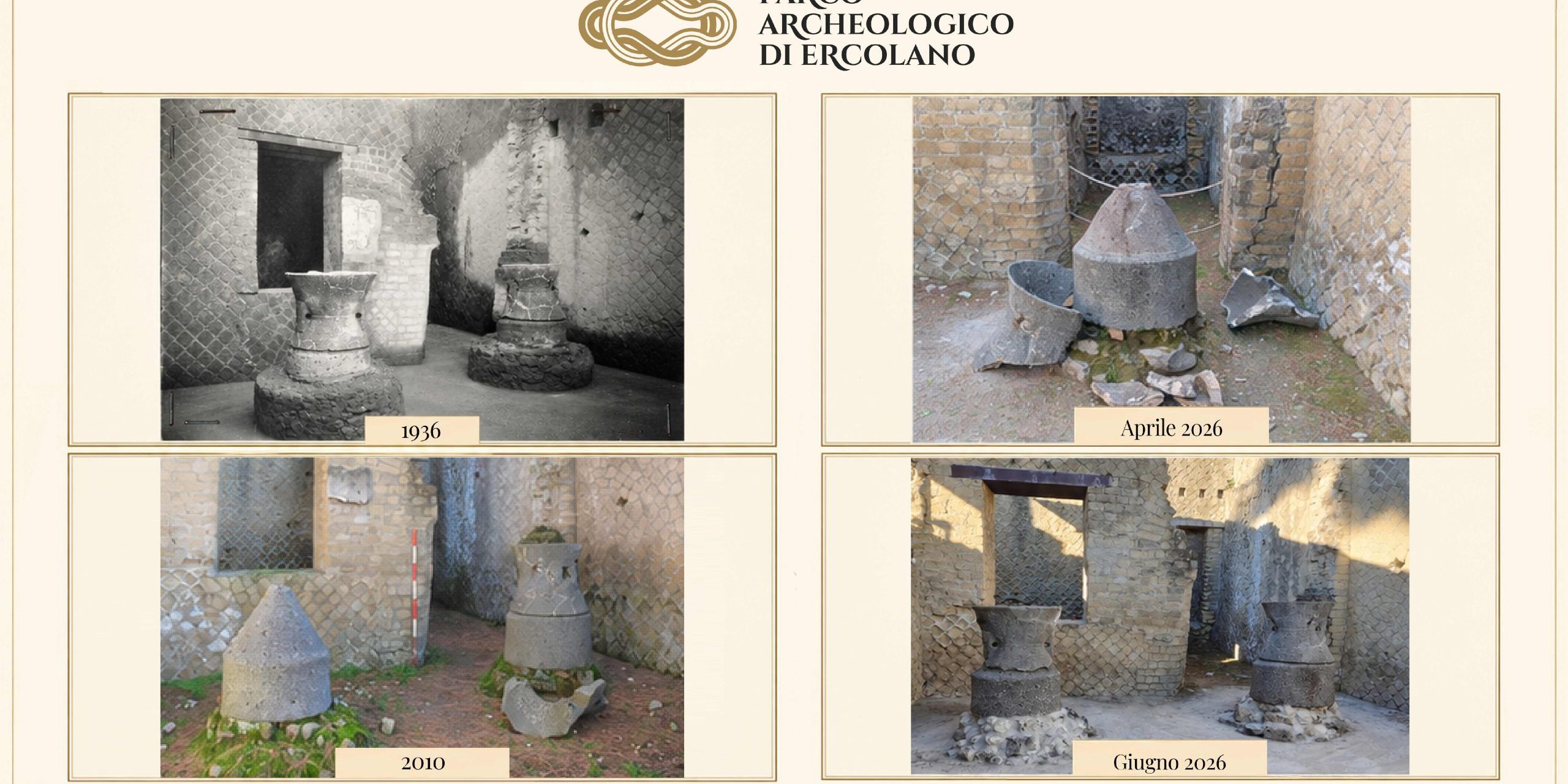
The restoration of the donkey-driven millstones and the oven at the ancient bakery has been completed; the public can once again discover the bakery shop up close, as well as the story of the little donkey discovered by Amedeo Maiuri.
Herculaneum Archaeological Park · Pistrinum, Insula Orientalis II 1a – Vicolo Meridionale
The Archaeological Park of Herculaneum continues its tireless maintenance and restoration work on its heritage, constantly expanding opportunities to visit and learn about the ancient city. Restoration work has recently been completed on two donkey-driven lava-stone millstones and the oven of the bakery (*pistrinum*) facing Vicolo Meridionale—one of two bakeries in the populous district near the Palaestra, alongside the bakery of Sextus Patulcius Felix.
The restoration restores full legibility to a space that—better than many others—conveys the daily reality of an ancient trade: here, amidst the large wood-fired oven, the water trough, and the two millstones turned by the rotary motion of pack animals, bread was produced for the entire neighborhood.
One bakery, two stories
The rooms actually reflect two phases of the city’s life. Before being converted into a bakery, the spaces now occupied by the storeroom and the small latrine formed a single area serving as a public latrine, featuring a long wooden bench that could accommodate up to ten people at once; the room containing the millstones likely served as a waiting area, while the large room at the back functioned as a changing room. It was only later—prior to the eruption of 79 AD—that the complex was transformed into the bakery we can visit today, complete with millstones, an oven, and a stable for the animals used in the milling process.
The story of the little donkey
At the base of one of the two millstones, the archaeologist Amedeo Maiuri—who led the excavations at Herculaneum between 1927 and 1961—discovered the skeleton of a small donkey, the animal whose tireless labor turned the grinding stone. Consistent with his innovative concept of an open-air museum, Maiuri chose to display the animal’s remains exactly where they were found, protected by an iron case; this display is no longer visible *in situ*, however, as the remains have been kept in storage since 1981.
It is a story that the Park now intends to tell using new tools: the restoration project was accompanied by comprehensive digital documentation of the artifacts—including 3D surveys—paving the way for future multimedia narratives (ranging from 3D reconstructions to social media content) designed to share the story of this small yet significant figure in daily life at Herculaneum with the public, including those unable to view the original remains.
“Every restoration project is also an opportunity to tell the story of antiquity using new tools. The history of this bakery—with its millstones and the little donkey discovered by Maiuri—speaks to us of daily life in ancient Herculaneum; today, thanks to the digital surveys carried out during the project, we can envision new ways to share this story with visitors to the Park and with those who follow us online.”
— Federica Colaiacomo, Director of the Archaeological Park of Herculaneum
Herculaneum bread: from Herculaneum to Rome
It is no coincidence that the subject of Herculanean bread is currently taking center stage well beyond the Park itself: until October 18, 2026, Castel Sant’Angelo in Rome is hosting the exhibition *Ercolano. L’arte di vivere* (Herculaneum: The Art of Living). Among the items on display are a loaf of bread carbonized during the eruption of Vesuvius and baking trays from the bakery of Sextus Patulcius Felix—the twin of the bakery found on Vicolo Meridionale. These two narratives intertwine—linking the Capital with ancient Herculaneum—to reveal the most everyday yet surprising facets of the city buried by Vesuvius.