



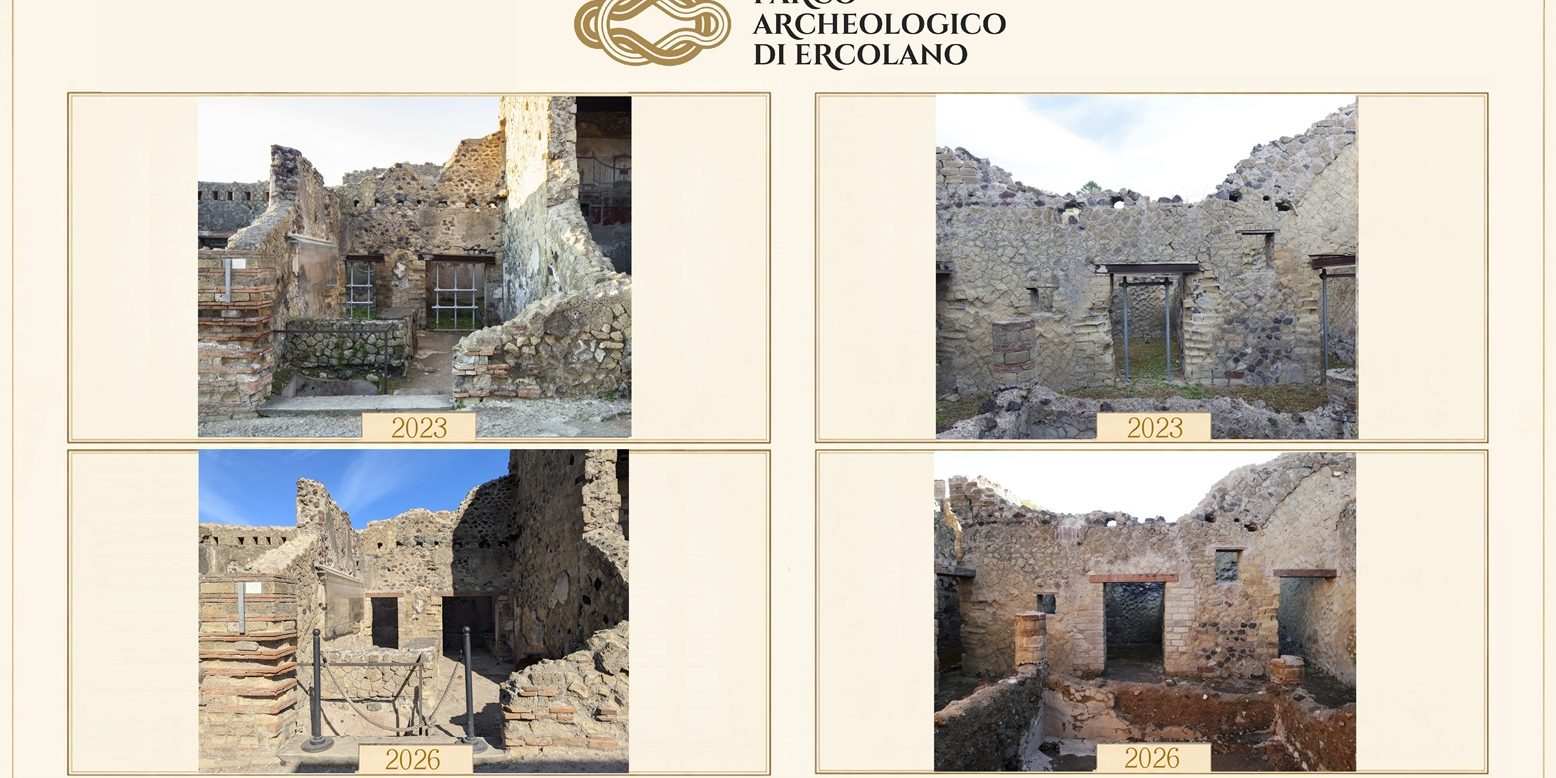
Extraordinary maintenance work continues at the Archaeological Park: a residential quarter, complete with its taberna, is once again open to visitors, just a few months before the opening of the Calchidicum trail
At the Herculaneum Archaeological Park, scheduled extraordinary maintenance work is continuing across the entire site. Thanks to these efforts, just a few months after the opening of the Calchidicum trail, the Workshop of Priapus—along with the adjacent residential quarter— is once again open to the public: an area of immense archaeological interest that had been closed to visitors for several years.
The work carried out in the taberna area and the residential quarter involved replacing wooden, steel beam, or reinforced concrete lintels that were in poor condition or no longer suitable for their structural function. The dilapidated elements were removed and replaced with solid azobé beams, followed by structural repairs to the historic masonry.
“Returning the Bottega di Priapo to the community means reopening one of the spaces that best illustrates daily life in ancient Herculaneum: a place where people ate, drank, socialized, and spent the night,” says Colaiacomo, director of the Herculaneum Archaeological Park. “After years of closure, thanks to constant and extensive maintenance work, we are once again making an area of extraordinary interest available to visitors in complete safety.”
A shop that tells the story of everyday life
Discovered during the major excavation campaign led by Amedeo Maiuri, the workshop owes its name to the depiction of Priapus, the god of fertility and prosperity, painted on the wall behind the counter with his large phallus pointing toward the entrance. As it has been unearthed from the mud of the eruption of 79 A.D., it offers a glimpse into the daily life of the ancient inhabitants of Herculaneum.
The small counter was used to sell food prepared in the kitchen, while a small cistern likely served to keep the wine cool. Another room, with stone benches along the walls, was a simple space where people could sit and eat a meal. Supplies were stored on the loft: one amphora contained Cretan wine, while others held over fifteen kilograms of fava beans, a legume that was a staple in the diet of the Vesuvian towns.
But the shop also concealed a more private space. Through a passageway behind the counter, one entered a storage area filled with pots, dishes, and other supplies, which led to a full-fledged dining room, with walls decorated with frescoes on a white background and red panels framing small still-life paintings. A small window connected the dining room directly to the counter: freshly prepared dishes were passed through it—a simple detail that perfectly brings the scene to life.
A Welcoming Place
Next to the shop stands a building directly connected to it, arranged over two floors and divided into numerous small rooms. Archaeologists hypothesize that it was not simply a private home, but a true place of hospitality: Priapus’s Shop was not merely a small inn, but a place where patrons could have a drink, enjoy a hot meal, sit in the dining room to discuss the private and public affairs of the day, and stay the night after a journey of varying length.
“Extraordinary maintenance is a priority for the Park,” adds Director Colaiacomo. “It’s an ongoing commitment, made possible by the work of our staff, as well as the professionals and companies that support us, to deliver to the public—one step at a time—a site that is increasingly accessible.”
The extraordinary maintenance of the site was funded under Law No. 190 of December 23, 2014, for the years 2025–2027, and involved park officials, external professionals, and companies specializing in the sector.