



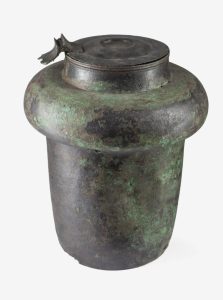
This bronze boiler, from the House of the Relief of Telephus, is an extraordinary example of Roman culinary technology. A symbol of the culinary ingenuity of the time, this vessel—with its small opening—was probably used to keep a constant supply of boiling water, essential for various kitchen tasks.
The rim of the container was shaped to accommodate a lid, which had a small hole to release steam. The lid was fastened to the vessel with an iron hinge, ensuring stability and safety during use. The absence of handles suggests the boiler was meant for fixed or semi-fixed use, likely placed inside a cylindrical hearth.
In Roman kitchens, boilers were commonly used to prepare soups, stews, and boiled dishes—staples of daily nourishment. Their large size allowed for the preparation of abundant quantities of food, meeting the needs of large families.
Boiling, already common in Greek tradition, became a dominant cooking technique in the Roman world. It not only enhanced the flavor of foods but also improved digestibility and aided in preservation—crucial in an era without refrigeration. Particularly tough and fibrous cuts of meat required long cooking times to become edible, making boilers indispensable for achieving the best results.
THE LEAD TANK
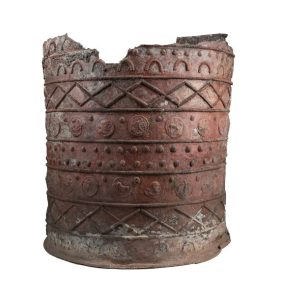
Found in the House of the Mosaic Atrium, this object (Latin: cista) is a finely crafted artisan product, symbolizing the refinement and technical expertise of the period. The cista was likely used to store water in domestic settings.
Its decoration is divided into eight bands featuring geometric patterns, shells, and medallions depicting deities and symbolic animals. Among the most notable figures are: a sculptor next to a statue of Minerva, a bull with Nike, Jupiter with his eagle, Diana with her bow, and a warrior in battle.
These cistae were generally placed in strategic parts of the house—like atriums and courtyards—to collect and store water. This particular one was found near the kitchen, where a steady water supply was essential.
Many of these tanks, or at least a significant number, are attributed to the engraver L. Clodius Hilarus, who lived during the reign of Emperor Augustus. Such artifacts are documented almost exclusively in the Vesuvian area—particularly in Pompeii—suggesting a specialized local production. Today, around fifty specimens are known, preserved in Pompeii, Herculaneum, and the National Archaeological Museum of Naples.