

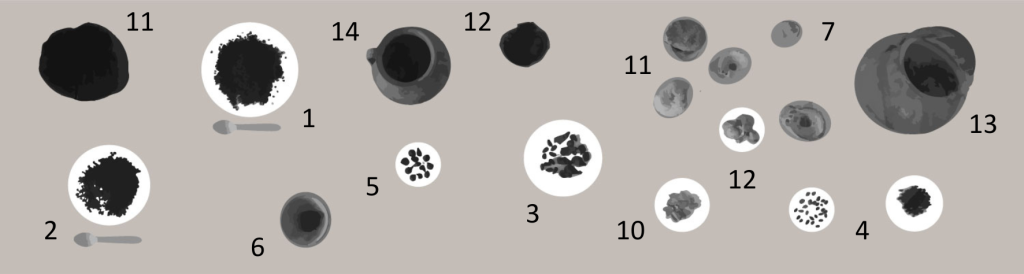
The focal point of this display area is the collection of carbonized organic remains, precious testimonies to the daily diet of the ancient inhabitants of Herculaneum.
Among the plant remains, notable quantities of legumes stand out, such as peas (1 – Pisum sativum) and field beans (2 – Vicia faba var. minor), the latter found in the House of the Wooden Partition. From the House of the Wattlework come pine nuts and fragments of cones from the stone pine (3 – Pinus pinea), alongside olive remains (4 – Olea europaea). These finds confirm the variety and seasonal nature of the foods consumed.
Also present are onions (5 – Allium cepa) and plums (6 – Prunus domestica), retrieved from suburban contexts of uncertain origin. Some of these remains are arranged within a small bowl, emphasizing their domestic use. All these ingredients – common and readily available – were widely used in Roman cuisine, particularly among the lower classes.
A particularly unique find is a Tonna galea (7), a large Mediterranean gastropod also appreciated for the beauty of its shell. Although edible, in antiquity it was often collected for practical and decorative purposes: the shell was reused as a liquid container, for pouring oil, or even repurposed as a lamp.
Next to it are displayed tellins (8), oysters (9), and limpets (10), small marine mollusks that enriched the Herculaneans’ diet with protein and briny flavor, highlighting the key role of coastal resources in daily nutrition.
The display concludes with two ollae (11 – 12) containing materials under chemical analysis for identification, a cooking pot (13), and a two-handled storage jar (14).