



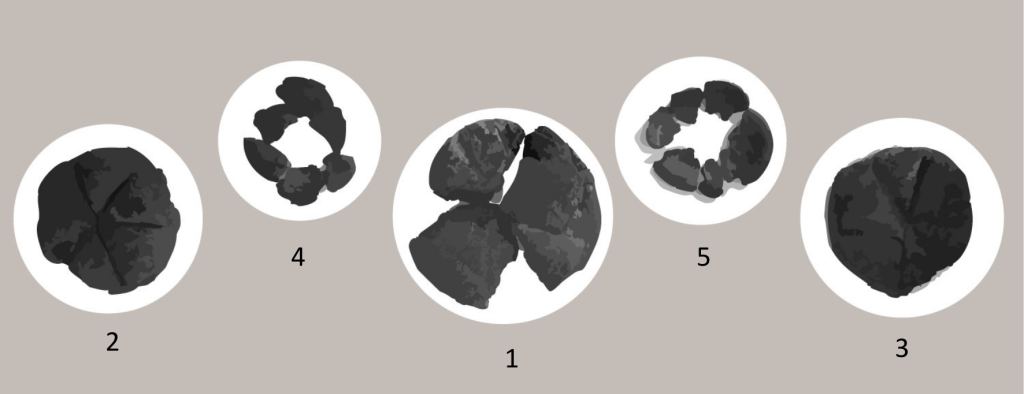
Displayed in this showcase are several examples of bread and flatbreads discovered in Herculaneum.
The most common type of bread had a round, slightly flattened shape with radial incisions on the surface to make it easier to divide into equal portions.
The most frequently attested shape in the Vesuvian area is the one divided into eight segments (1), from which the name panis quadratus derives: the term quadra, in fact, referred to the process of dividing the loaf first in half, then into four parts.
Two almost perfectly preserved loaves have survived to this day, each divided into six segments: one comes from the House of the Brick Altar (Casa dell’Ara Laterizia) (2), the other from the Palestra area (3).
In Roman times, it was customary to imprint rectangular stamps on loaves, probably used to indicate their origin or owner. Bread was often kneaded at home and then baked in public ovens, which were numerous in Vesuvian towns. On one of the loaves, from the House of the Brick Altar, a stamp with the letters “VM” is still visible – clearly legible, though its meaning remains uncertain.
Particularly interesting are the flatbreads (3 – 4), which are small, circular, and similar to biscuits. They have a concave shape and a central hole, likely once tied with a string that is now lost. Probably baked in molds, their surfaces display geometric decorations and vegetal motifs. Three groups of these flatbreads were found stacked along the roadway of the Lower Decumanus, likely displayed for sale in thermopolia, the ancient street food shops.