



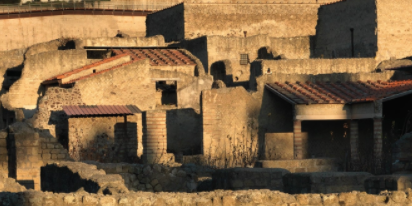
On May 29, 2026, the Ercolano Archaeological Park will welcome students and faculty from the University of Naples Federico II, the École du Louvre in Paris, and the Université de Lille for a day of advanced training on accessibility, community, and digital innovation in cultural heritage.
An archaeological site as a classroom. This is not a metaphor, but the concrete choice made by the Herculaneum Archaeological Park in hosting, on Friday, May 29, 2026, the international advanced training seminar “Antiqua. Narrating the Past. Archaeology and Museology,” promoted by the University of Naples Federico II as part of an internationalization project with the École du Louvre in Paris and the Université de Lille.
The day—which will include seminar sessions in the Antiquarium’s lecture hall and a guided tour of the site—will focus on three themes the Park practices daily: accessibility to heritage, engagement with local communities, and digital innovation as a storytelling tool.
Accessibility and community: heritage as a service
The conference will open with a presentation by Federica Colaiacomo, Director of the Herculaneum Archaeological Park, and archaeologist Maricarmen Pepe, with a presentation on “Accessibility and Education: Heritage, Schools, and Communities.” This presentation will explore the strategies the Park is using to make Herculaneum a accessible and meaningful place for a variety of audiences, from local schools to local communities.
Following this, Sarah Senatore, Community Consultant at the Packard Humanities Institute—a longtime partner of the Park—will illustrate the local community engagement projects developed in collaboration with Ercolano: a model in which archaeology and civic life are intertwined in a concrete way, starting from the understanding that a UNESCO site belongs first and foremost to those who live nearby.
Digital Herculaneum: The Past Accessible Online
Archaeologist Simone Marino will present the Herculaneum Archaeological Park’s online platform: a tool that extends the site beyond its physical confines, making collections, scientific content, and educational tools accessible remotely. A digital window onto one of the world’s best-preserved Roman cities, designed to reach those who can’t visit in person and to enrich the experience of those who can.
The morning will conclude with a guided tour of the site, led by Park officials and professionals from the Packard Humanities Institute: a way to translate what was covered in the seminar sessions into direct experience.
Herculaneum as an international laboratory
The choice of Herculaneum as the venue for the seminar is no coincidence. The Park has been an international reference point for years, not only for the extraordinary quality of its heritage, but also for the way it manages it: with an approach that integrates scientific research, accessibility, sustainability, and local roots.
Hosting an advanced training program involving three European universities means bringing to the site the generation that will study, manage, and narrate cultural heritage for decades to come. An investment in the future of the discipline, one that comes from a direct encounter with one of the most emblematic sites in world archaeology.
The “Antiqua. Narrare il Passato” seminar is part of a broader effort to open the Park to university education and international cooperation, in the belief that enhancing heritage also depends on those who study and teach it.