



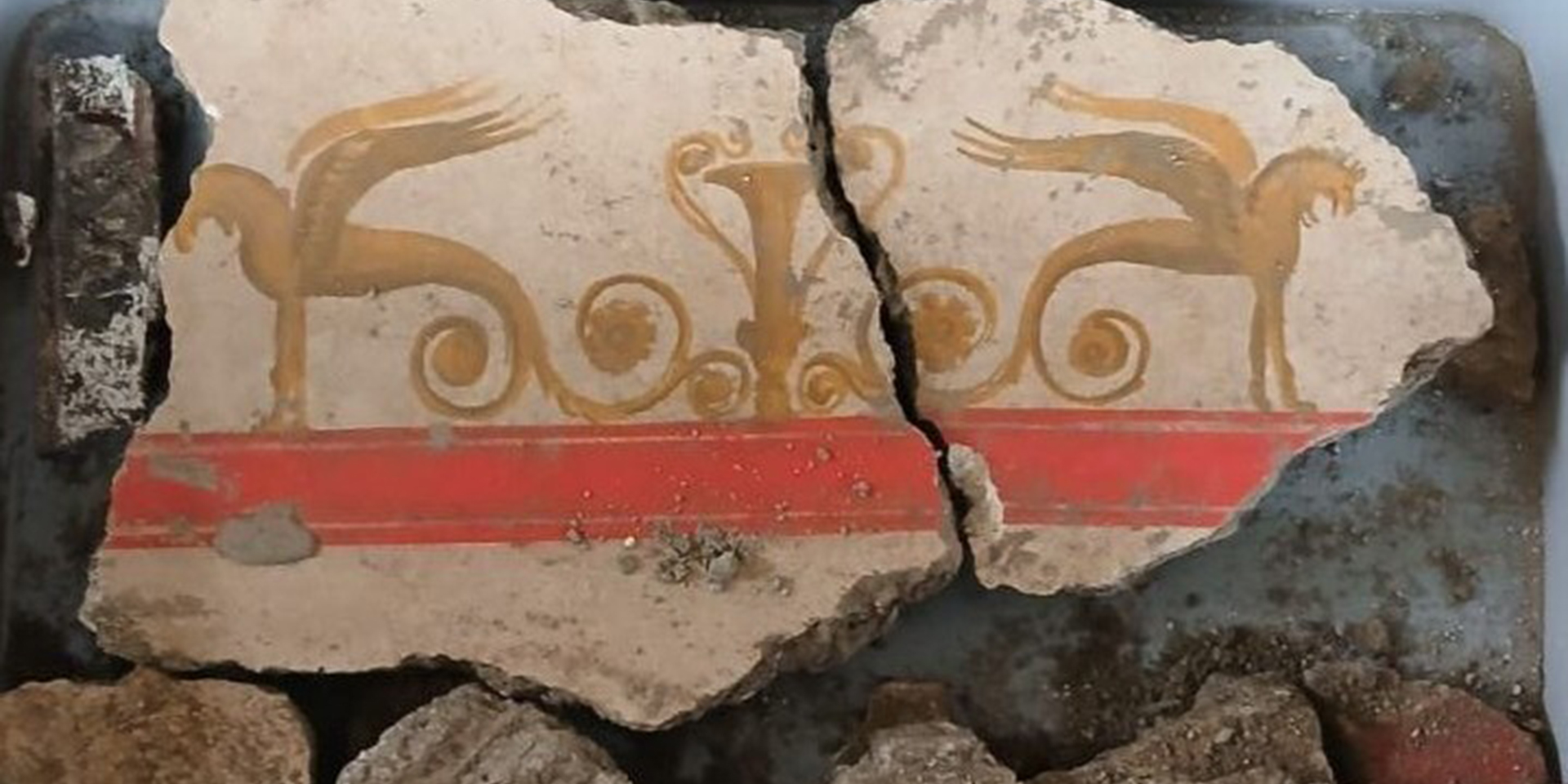
A new room reveals high-quality decorations, pictorial apparatus and traces of a construction site in activity at the time of the eruption in 79 AD.
More than thirty years after the last systematic investigations, Villa Sora, in the municipality of Torre del Greco, once again tells its story. New archaeological research begun in November 2025 is yielding intriguing data on one of the most significant seaside villas in the Gulf of Naples, offering new insights into a complex of extraordinary richness, still largely unexplored.
The new project, conducted by the Herculaneum Archaeological Park, significantly expands the knowledge of the villa, leading to the identification of previously unexplored contexts and a more precise reconstruction of the residence’s lifespan, abruptly interrupted by the eruption of 79 AD. The investigations focused on the northeastern front of the villa, where a small room, approximately 10 square meters, but of exceptional decorative quality was documented.
“The results of the Villa Sora excavation confirm the importance of archaeological research as an essential tool for knowledge. The new evidence not only allows us to acquire previously unpublished data, but also to reveal concrete aspects of daily life in a large seaside villa, suddenly interrupted by the eruption of 79 AD. This advancement in knowledge offers a more solid foundation for strengthening the site’s valorization processes and for making its narrative more informed and detailed to the public. ”, commented the General Director of Museums Massimo Osanna.
The excavation project is part of the National Archaeological Excavation Campaign promoted by the Directorate-General of Museums, launched in 2024 with the aim of supporting planned and ongoing research throughout the country. The campaign, strengthened in 2025 by a total allocation of €4.8 million, allows for the continuity of existing projects and the expansion of the effort nationwide. At Villa Sora, the €150,000 funding has revitalized an already underway awareness program, laying the foundation for a broader and more structured program of study and enhancement of the archaeological area.
The pictorial fragments discovered, referring to the walls and ceiling, reveal a highly refined decorative scheme. The walls, painted against a dark background punctuated by bands of cinnabar red, were enlivened by figurative elements, including herons arranged around a golden candelabra. The ceiling, with a light background, was adorned with garlands, friezes, and mythological figures: among these, griffins, inserted into a rich ornamental repertoire, stand out, as well as the figure of a moving centaur, of remarkable pictorial quality.

Of particular significance is the context in which these decorative elements were discovered. Inside the room were three finely decorated lead cistae, attributable to the same workshop, along with high-quality white marble architectural elements, including a capital preserved in excellent condition. The quality of the workmanship, carried out exclusively by chisel, and the presence of additional marble fragments—including a second capital fragment—clearly indicate the intentional storage of elements intended for an ongoing architectural project. Taken together, these findings suggest a space used as a storage area or construction site, confirming the hypothesis that the villa was undergoing construction work at the time of the eruption.
Stratigraphic analysis has allowed us to clearly reconstruct the sequence of destructive events, highlighting the impact of the pyroclastic flows that struck the buildings and caused the collapse of the roofs and ceilings, and the subsequent collapse of the walls. This picture powerfully conveys the violence of the catastrophe.
Built around the middle of the 1st century BC and subsequently renovated until its destruction, Villa Sora extended along the coastline with a dramatic layout, structured on terraces sloping down towards the sea. The estimated extension of the complex, approximately 150 meters along the coast, conveys the image of a high-end residence, featuring highly refined residential and reception rooms.