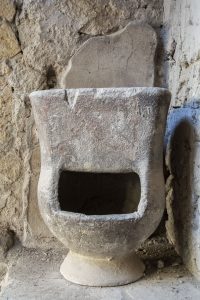
Identified as a “stove” by Amedeo Maiuri, the artifact comes from the so-called Shop V, a commercial space that was part of the renowned House of the Bicentenary. This area, structured on multiple levels with a back room and living quarters on the upper floor, yielded a significant collection of materials related to daily activities, including a dolium and a cupboard filled with pottery.
The so-called stove was presumably used for cooking food.
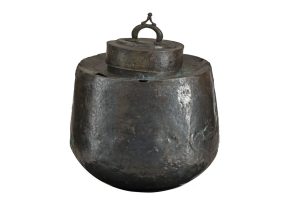
Next to it is a fine bronze cauldron with a lid, discovered in the House of the Tuscan Colonnade, a domus with a clear commercial vocation overlooking the Decumanus Maximus.
The artifact is notable for its solid and functional shape. The body is cylindrical and tapers toward the bottom, making it ideal for resting on an iron tripod within a hearth.
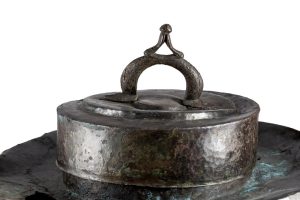
The lid, also made of bronze, is movable and fits perfectly onto the neck of the cauldron. The most striking feature is the decorative handle at the top, composed of two stylized dolphins depicted in the act of diving, with their tails raised and joined to form a triangular loop. This particular detail was likely intended to allow for the attachment of a chain, as suggested by comparisons with other similar finds. Above the loop is a small domed grip, finely engraved, used to lift the lid.
The entire handle is enriched with V-shaped engravings and fine lines that depict the skin and gills of the dolphins, adding an artistic touch to an object otherwise intended for everyday use.
Stoves, hot water containers, and vessels used for storing food supplies were essential furnishings in shops dedicated to the preparation, sale, and consumption of food and drink. These were often accompanied by masonry counters and display structures—frequently arranged on one or more levels and clad in elegant marble slabs—that combined practicality with aesthetic appeal, helping to define the character of the commercial space.
Such furnishing solutions were widely used in the shops of Herculaneum, where roughly a quarter of the identified economic activities were related to the food and hospitality sector.